
Answer types
For each question you decide what shape the answer should be stored in. The called person answers freely, in their own words — the type says what should be taken out of those words.
Three answer types, and the three shapes they are shown in.
There are three, and the results look different with each.
Yes/No
For questions answered by confirming or denying: Did you take all your medicines today? Does your head hurt today?
Yes or No is stored. The results appear as a grid of coloured tiles —
one per call, so a run is visible at a glance.
The summary shows the last answer, the most common answer and the counts of both.
Call again until the answer is yes
A yes/no question has the option Call again until the answer is yes (off by default). It suits reminders such as Have you taken your pills today?, where what matters is that the thing gets done. Once on, you set:
- Interval: how long after the end of the call to call again — 30 minutes, 1 hour (default), 2 hours or 4 hours.
- Number of repeats: 1 to 5 (default 3).
What happens:
- If the answer in a call is "no", "I don't know" or evasive, Hana calls again after the set time and asks only this question. A clear "yes" ends the repeats.
- Hana does not press or advise on a "no"; she only says when she will call again ("All right, I will call you again around 3:00 PM.").
- An attempt is only a call that somebody picked up and in which the question was asked. A call nobody answers follows the usual rules for retrying a failed call and does not count towards the number of repeats.
- A repeat applies only to the day the question was asked: nobody is called between 9:00 PM and 7:00 AM, and a repeat never moves to the next day. A repeat that would fall at night is not scheduled.
- If a repeat falls close to a scheduled call, that call takes it over and asks the questions of both. A repeat never skips the next scheduled occurrence of the same question; that one asks it.
- When the repeats run out, it is only recorded: the question's history shows "Yes was not heard even after N repeats" on the entry. You get no notification.
- Billing: every repeated call is billed like a regular call.
Numeric
For measured values: What was your body temperature this morning? What was your upper blood pressure reading today?
A number is stored. The results appear as a chart over time, and the summary works out the minimum, maximum and average.
Ask about one figure per question and say what units you want — why, is on Wording a question.
Text
For everything that fits neither a number nor a yes/no: How did you sleep last night?
What the person said is stored, condensed into a sentence. The results appear as a list of answers, newest first.
A text answer cannot be added up or averaged. Consider whether the question could be put so that it yields a number or a yes/no — those are far easier to work with.
Answer detail
On a text question you choose how detailed an answer you want:
The assistant asks at most once, then takes anything, even "I don't know". A more detailed answer means a longer, and so pricier, call.
Meaningful answer
On a question of any type you choose how firmly the assistant insists that the answer actually relates to the question:
The default is to accept any answer. Meaningfulness is judged first, and only an answer that does answer the question is then checked for the detail of a text answer. Follow-up questions make the call longer, and so pricier, so insist on an answer only where it really matters.
When no answer can be extracted
Not every call ends in a value, and the service does not paper over it. The question's history shows these cases:
An ambiguous answer comes with a quotation — verbatim what the called person said. It often shows that the person answered perfectly well and it simply could not be written into the requested type.
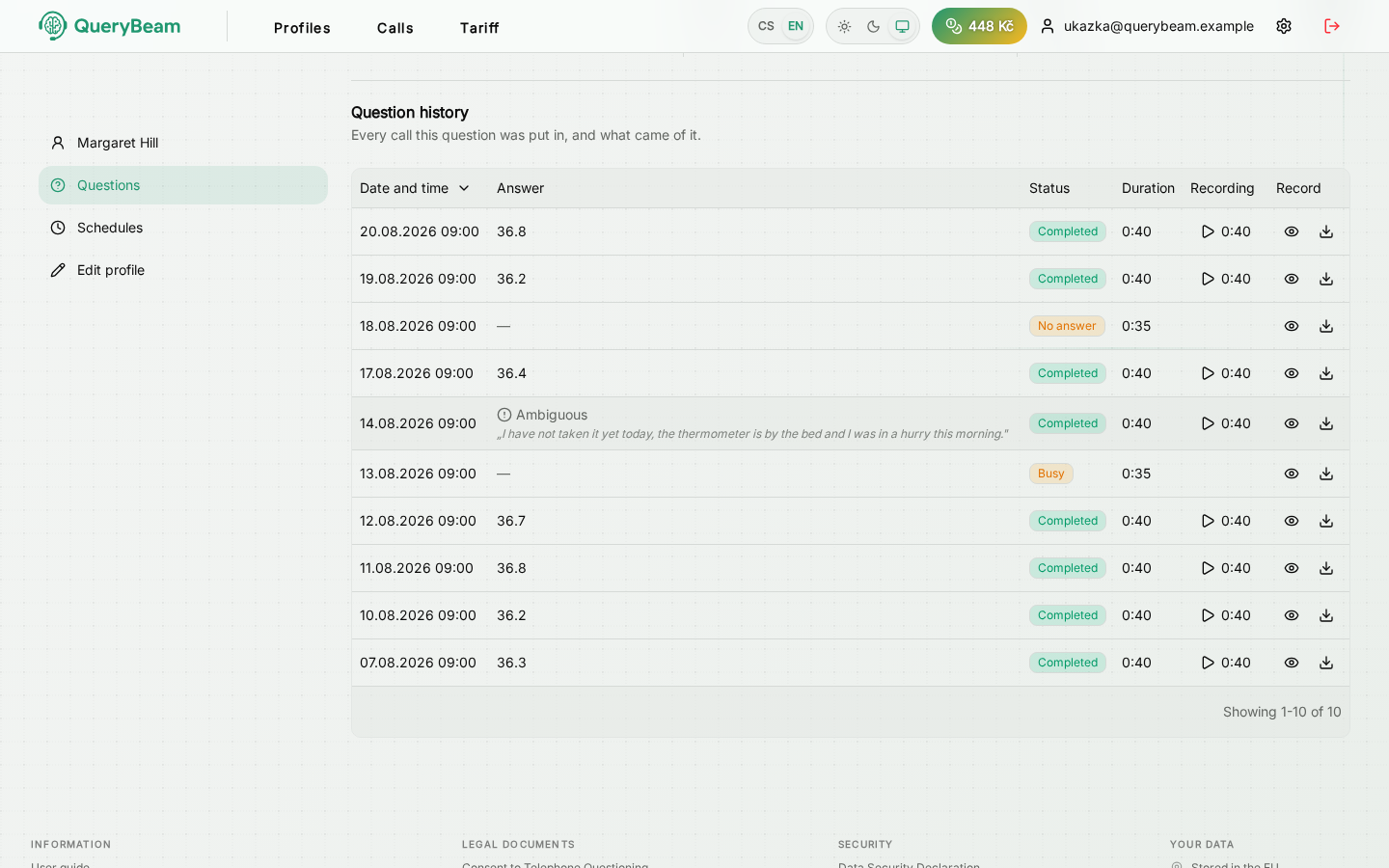
"I haven't measured it yet today, the thermometer is by the bed and I was in a hurry this morning." An answer it is; a number it is not.
It is also the best signal that a question is badly put. A few ambiguous answers in a row usually mean you are asking about two things at once, or not saying what units you want.
Changing the type
The answer type of an existing question can be switched (the pencil in its row). Earlier answers are not recomputed, though — they stay stored in the type they were created in. For a question that has already collected something, it is cleaner to create a new one.