
What QueryBeam does
You enter what should be asked and when. At the agreed time an automated voice assistant calls, puts your questions, and writes down what the person answers — together with the verbatim sentence it read the answer out of.
Nothing more. It is a tool for collecting answers by telephone, not for judging them.
The tour
The whole application in brief: profiles, questions, schedules, calls and answers.
What it looks like in practice
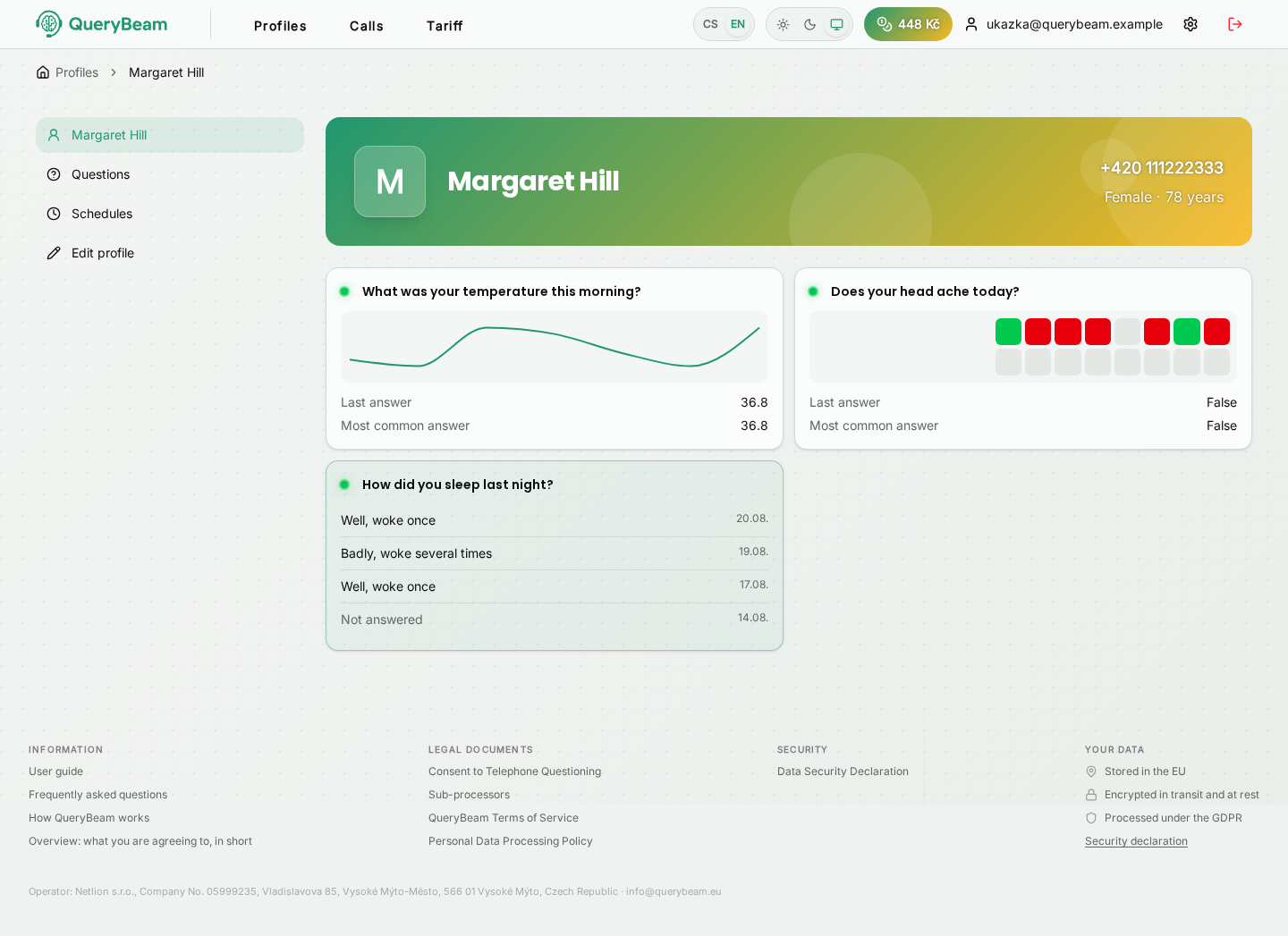
A profile called every weekday at nine. Three questions, three different shapes of answer.
Calling turns on three things you set up:
The schedule is turned into a plan of calls. At the appointed hour the telephone rings, the assistant introduces itself, puts the questions and listens to the answers. The call becomes a transcript, and from the transcript an answer is extracted for each question.
An answer has three layers
This is the one thing worth understanding before anything else, because how you work with the results follows from it:
- The value — "36.8". The bare datum, in the type you asked for.
- The source quotation — "I measured thirty-six eight." Verbatim what the called person said, kept with the value.
- The call record — the recording and transcript of the whole conversation.
Extracting a value from free speech is done by a machine and is not error-free. That is why every value shows what it came from. Before you do anything significant on the basis of a number, open the quotation — it is one click.
The recording and transcript are kept for 12 months and then deleted. The quotation stays with the value for as long as the value exists.
What the service does not do
This is not a list of missing features. It is a definition of the product:
- it makes no diagnosis and suggests none,
- it does not assess health status and recommends no treatment,
- it does not compare answers against thresholds and raises no alert,
- it computes no scores or indices and does not interpret a trend,
- it is not for urgent situations and does not replace being able to reach a doctor.
Assessment of what was said belongs to a human being. The service delivers the answer and its source; what follows from it is your decision.
A call is scheduled in advance, need not happen, and nobody monitors it live. If somebody's health deteriorates, that is for a doctor or the emergency number.
Only somebody who consented can be called
A message goes to the number entered, carrying a code and the text the called person agrees to by confirming it: that an automated assistant may call them and that the call is recorded. Until somebody confirms that code, the service places no call. The code goes to the called person, not to you.
The detail is on Verifying the number and consent.
Where to next
- Signing up and signing in — before you begin
- Your first call, step by step — from an empty account to a scheduled call
- How QueryBeam works — a fuller description, including where the data travels